
Winter Trail Traction: Hiking Tip
We recommend trail crampons for slippery conditions

Benefits:
-Feel safer and cover more ground on winter ice and snow
The Verdict:
-Mandatory gear for slippery winter hikes
Cons:
-Heavy to carry when you're not using them

Click the image below to watch our Youtube Short on using trail crampons.
(opens in new tab)
As a guy who grew up in Northern Ontario, I’m surprised I’d never heard of trail crampons until we started doing mountain hikes. I discovered them in my research for our New Zealand trip. Since we were going to be there in winter, a lot of influencers were suggesting we would need them for the Alpine hikes, and so I picked up four pairs of the Hillsound Trail Crampons for the fam.
We only used them on one hike in New Zealand (Roy’s Peak), so was it money well spent? Well, put it this way. Roy’s Peak was my wife’s #1 bucket list hike. Imagine not being able to do it after flying halfway across the world because the trail was too slippery? So, yup, it was money well spent!


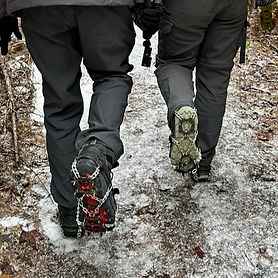
What are trail crampons? Let's start with what they are not. They are not mountaineering gear designed for mountain climbing. You do not need any training to use them. They are simply spikes that attach to the bottom of your shoe or boot. In the case of our HillSound Trail Crampons, they have a rubber frame that stretches over your shoe or boot upper along with a strap to keep them snug. Then chains run from the upper to the spikes underfoot.
The Hillsound Trail Crampons that we use stay on your footwear with no slipping or shifting. And surprisingly given the aggressive spikes on them, you don't really notice them when you're walking (other than the massively increased traction).


Since New Zealand, we’ve hiked exclusively in North America, and what I’ve noticed is that we use the hiking crampons regularly in the Southern Ontario winter. Temperatures here hover around freezing, which means a lot of freeze-thaw-freeze cycles, which means a lot of glare ice on trails. Just last week we used the Hillsounds in Algonquin Park on the Highlands Backpacking Trail. Even though it was only a few degrees below freezing, all low lying points of the trail were treacherously icy. We tried to go without them but after several near falls, we put them on. Once on, a stressful hike became fun again: we could just enjoy our time in nature without worrying about the ice underfoot.
Trail crampons are equally handy in mud. We encountered a snow and mud mix at the top of C-Level Cirque in Banff last year in July, and they would have been useful at the top, but we didn't bring them for this summer hike. Thank goodness we had our poles with us, as it was very slippery in the steep areas. I only mention this to point out that in Alpine areas, the season for trail crampons is almost 12 months long!

The bottom line is this: if you have the crampons with you, you won't have to bail on a hike or turn around halfway because the trail is too slippery. For folks like us who often drive 2 to 3 hours to get to a trailhead, that's super valuable.
Trail crampons are one of the first dedicated hiking gear items that we bought, and we'd highly recommend them to anyone who wants to hike in all four seasons.
If you want to read our review of the HillSound Crampons, click here.
If you're interested in buying a set of trail crampons for yourself, you can use the buttons at the bottom of the page. Some links may be affiliate links.